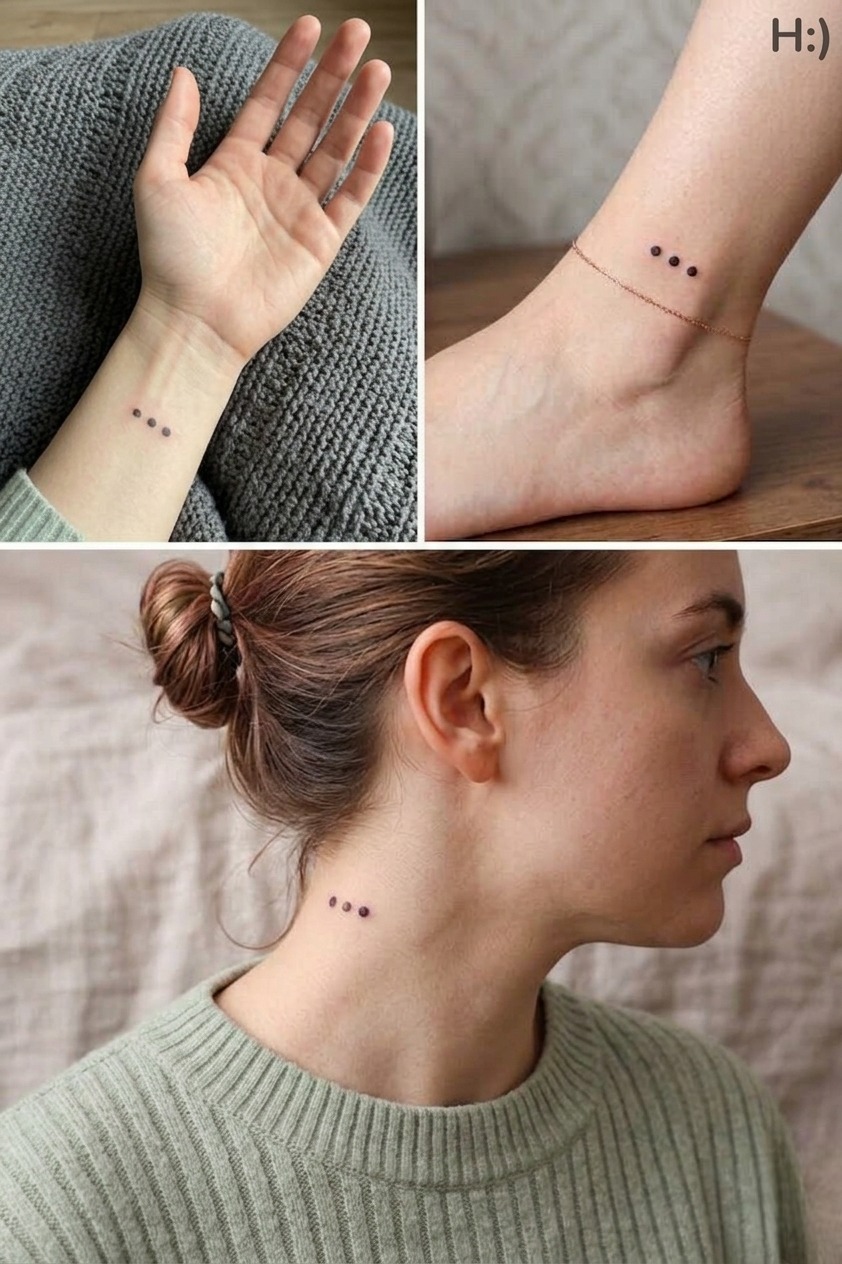
The three-dot tattoo, often rendered as a simple triangular cluster (•••), is one of those rare symbols that manages to be both minimal in appearance and vast in meaning. At first glance, it may seem like nothing more than a small aesthetic choice—something subtle, perhaps even random. Yet beneath that simplicity lies a depth shaped by culture, history, personal identity, and environment. What makes this symbol particularly fascinating is that it does not belong to a single narrative. Instead, it exists at the intersection of multiple interpretations, each one valid within its own context. This ambiguity is precisely what gives the tattoo its power. Unlike more explicit designs, the three dots do not declare their meaning openly. They invite curiosity, sometimes even misunderstanding, depending on who is observing and where. For the person wearing it, however, the meaning is often deeply intentional, even if it remains unspoken. This quiet, almost coded nature transforms the tattoo into something more than decoration—it becomes a personal or cultural statement that operates beneath the surface of everyday perception.
One of the most widely recognized interpretations of the three-dot tattoo connects it to the philosophical idea of “see no evil, hear no evil, speak no evil.” In this context, the dots represent a form of restraint, a deliberate choice to avoid engaging in negativity or wrongdoing. However, this meaning often evolves depending on the environment in which the tattoo appears. In more restrictive or high-stakes settings, such as prison systems, the phrase takes on a different tone. It shifts from a general moral guideline to a more specific code of conduct—one that emphasizes silence, loyalty, and non-cooperation. Here, the tattoo can symbolize a refusal to speak to authorities or betray others, functioning as a silent declaration of allegiance to an unwritten set of rules. This interpretation highlights how meaning is not fixed but shaped by circumstance. The same three dots that might represent peaceful restraint in one context can signal defiance or solidarity in another. This duality is part of what makes the tattoo so enduring and widely recognized across different communities.
Beyond philosophical symbolism, the three-dot tattoo is often associated with identity and belonging, particularly within tightly knit groups. In environments where trust is essential and must be established quickly, visual markers like tattoos can serve as a form of communication. The three dots, in this sense, act as a signal—subtle but meaningful to those who understand it. They can indicate shared experience, mutual understanding, or adherence to a particular set of values. This does not necessarily mean that every person with such a tattoo belongs to a specific group, but within certain circles, the symbol carries weight. It becomes part of a visual language that conveys information without words. For individuals who have lived through intense or formative experiences, the tattoo may represent survival, resilience, or loyalty. It can function as a reminder of where they have been and what they have endured. At the same time, it may also serve as a way to connect with others who recognize its significance. This sense of connection—whether explicit or implied—adds another layer to the tattoo’s meaning, reinforcing its role as both a personal and social symbol.
In other cultural contexts, particularly in parts of Latin America and among certain youth subcultures, the three-dot tattoo is commonly interpreted as “mi vida loca,” or “my crazy life.” This phrase reflects a different kind of meaning—one rooted in personal experience rather than philosophical or institutional codes. Here, the tattoo becomes a declaration of a life lived outside conventional boundaries, often marked by risk, unpredictability, or rebellion. It may represent past struggles, difficult circumstances, or a refusal to conform to societal expectations. Unlike more structured interpretations, this version of the meaning is fluid and highly individual. For some, it may symbolize hardship and survival; for others, it may reflect a sense of freedom or defiance. What remains consistent is the idea that the tattoo tells a story. It is not just about the dots themselves, but about what they represent in the context of a person’s life. This storytelling aspect is central to many forms of body art, but it is particularly pronounced in symbols as open-ended as the three dots. The lack of a single fixed meaning allows individuals to project their own experiences onto the design, making it uniquely personal.
At the same time, the three-dot tattoo is not without its challenges, particularly when it comes to perception and stigma. Because of its associations with certain environments or lifestyles, the tattoo can influence how others interpret the person who wears it. In some cases, this may lead to assumptions that are not accurate or fair. A symbol that holds deep personal meaning for one individual may be viewed through a completely different lens by someone else. This disconnect can create tension, especially in situations where first impressions matter. It highlights a broader issue with symbolic interpretation: the tendency to assign meaning without understanding context. Tattoos, like any form of expression, exist within a social framework, and their impact is shaped not only by intention but also by perception. For some people, this means navigating a balance between self-expression and societal expectations. The three-dot tattoo, with its layered meanings and associations, exemplifies this complexity. It serves as a reminder that symbols are rarely neutral—they carry histories and connotations that extend beyond the individual.
Ultimately, the enduring significance of the three-dot tattoo lies in its ability to hold multiple meanings at once. It is a symbol that resists simplification, existing as a blend of philosophy, identity, culture, and personal narrative. Its small size belies its depth, making it one of the most intriguing examples of how minimal design can convey profound ideas. For some, it represents silence and restraint; for others, loyalty, survival, or a life shaped by unconventional paths. It can be a marker of belonging, a reminder of past experiences, or simply a personal emblem that holds meaning known only to the wearer. What unites these interpretations is the idea that meaning is not inherent in the symbol itself, but created through context and experience. This makes the three-dot tattoo not just a piece of body art, but a reflection of the human tendency to encode meaning into even the simplest forms. It reminds us that understanding requires more than observation—it requires curiosity, openness, and a willingness to look beyond the surface.
