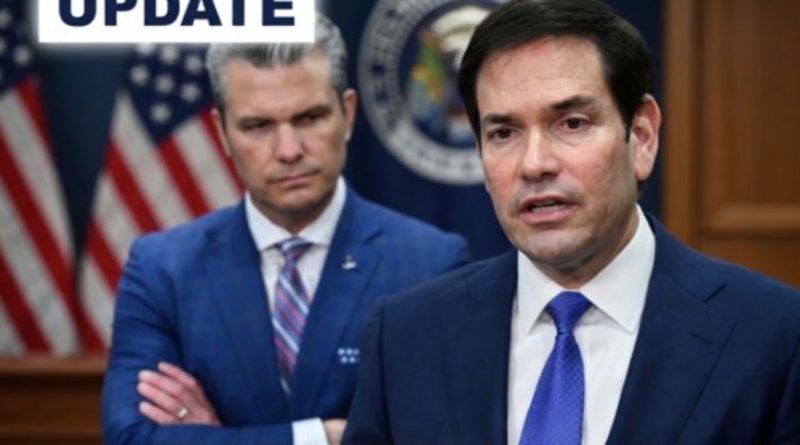
Marco Rubio said Tuesday that the recent U.S. strike on Iran was intended to permanently eliminate what he described as the country’s nuclear threat, emphasizing that the objective had been clear from the beginning.
“This was the final, best chance to wipe out Iran’s threat for good — so they can never have a nuclear weapon,” Rubio said in a video shared on X. He added that while Iran could pursue civilian nuclear energy, he accused Tehran of developing concealed facilities capable of enriching material to weapons-grade levels.
“They build their reactors and their facilities deep in mountains away from the public glare,” Rubio said, according to reporting cited by Fox News. “The same equipment used for civilian energy could quickly be used to enrich material to weapons-grade.”
Rubio also warned that Iran had been working to develop a large stockpile of missiles and drones that could protect its nuclear infrastructure. He described that possibility as an “intolerable risk” and said the U.S. operation was also designed to weaken those capabilities.
Speaking on Hannity, hosted by Sean Hannity, Rubio said the United States remains open to direct talks with Tehran but cautioned that negotiations would not be allowed to stall progress.
“There is the potential for a direct meeting at some point,” Rubio said. “But what President Donald Trump is not going to allow is fake negotiations to be used as a delay tactic.”
Rubio added that the U.S. was “very, very close” to achieving its objectives and claimed that recent actions had significantly weakened Iran.
“This is the weakest Iran has been in 25 years,” Rubio said. “This is the weakest Iran has ever been.”
During the same discussion, Rubio warned that Iran had been pursuing missile capabilities that could eventually reach the continental United States, comparing Tehran’s ambitions to those of North Korea.
“That’s what they were aiming to do,” Rubio said. “They were aiming to become the next North Korea.”
In a separate interview with Al Jazeera Media Network, Rubio also criticized European allies and suggested the United States may need to reassess aspects of its relationship with NATO. He pointed to reported restrictions on U.S. military operations during the conflict.
According to reporting cited by Breitbart News, Rubio said some NATO members, including Spain, denied U.S. access to airspace and bases during the operation. He questioned whether such arrangements remain beneficial if allies do not provide support during critical moments.
“If that’s the arrangement, that’s a hard one to stay engaged in and say this is good for the United States,” Rubio said, adding that the situation would need to be reviewed.
The administration also expressed frustration with the United Kingdom over initial hesitation to allow strikes from the joint U.S.-UK facility on Diego Garcia. British officials later allowed use of airbases, which reportedly became an important staging point for operations.
President Donald Trump also criticized European allies over their response to the conflict and security concerns involving the Strait of Hormuz. He urged countries dependent on the route for energy supplies to take greater responsibility for their own security.
“You’ll have to start learning how to fight for yourself,” Trump wrote on Truth Social. “The U.S.A. won’t be there to help you anymore.”
Trump also criticized France for reportedly declining to assist U.S. operations related to Iran, saying the United States would remember the level of support provided by allies moving forward.
