“Where’s Lucy’s cello?” I asked.
My mother raised her coffee mug like I had interrupted a peaceful breakfast instead of walking into a house that smelled like wet paint, sawdust, chlorine, and money.
Dad sat at the kitchen table scrolling through his tablet.
My younger sister Rachel leaned against the counter with a tall green drink in one hand, dressed in expensive workout clothes even though she had clearly not been exercising.
Outside, three contractors were working around the enormous hole that had been carved into my parents’ backyard.
Steel forms.
Fresh concrete.
Stacks of pale stone.
A new in-ground pool.
Inside Grandma Margaret’s old music room, the corner where my eleven-year-old daughter’s antique cello had always rested was empty.
The velvet-lined stand was still there.
The small bench Grandma had used when she taught Lucy was still beneath the window.
Even the faded photograph of Grandma playing in a string quartet when she was twenty-three still hung above the piano.
But the cello was gone.
Lucy stood beside the empty stand, staring at it.
She wasn’t crying.
That somehow made it worse.
She had both hands clasped in front of her, shoulders slightly hunched, as if she had already decided that whatever had happened must somehow be her fault.
Mom gave me a thin smile.
“Your father handled it.”
I slowly turned toward Dad.
“Handled it how?”
He didn’t answer immediately.
That was when I knew.
“Dad?”
He placed his tablet flat on the table and sighed.
“We sold it.”
For a second, I genuinely thought I had misheard him.
“You did what?”
“It was valuable,” he said. “And it was sitting around collecting dust.”
“It was not sitting around collecting dust.”
“Emily—”
“Lucy plays it every week.”
Rachel rolled her eyes.
“She’s eleven.”
I stared at her.
“What does that have to do with anything?”
“It means she doesn’t need an eighty-thousand-dollar instrument.”
Lucy flinched.
I saw it.
Rachel didn’t.
Or didn’t care.
Mom set her mug down.
“Don’t turn this into one of your scenes.”
“One of my scenes?”
“We made a family decision.”
I looked out through the sliding glass doors.
The pool stretched almost the entire width of the backyard.
There was going to be a hot tub attached to it.
A stone waterfall had already been built along one side.
Beside the patio sat boxes containing what looked like an outdoor kitchen.
I looked back at them.
“How much?”
Dad rubbed his forehead.
“Emily.”
“How much did you sell my daughter’s cello for?”
Rachel suddenly became interested in her drink.
Mom answered.
“Eighty-seven thousand dollars.”
The room seemed to become silent around me.
Even though power tools were whining outside, I barely heard them.
“Eighty-seven thousand.”
“Yes.”
“And you spent it on the pool.”
Mom crossed her arms.
“We contributed it toward the pool.”
Rachel immediately corrected her.
“It’s not just a pool. There’s landscaping, the patio extension, the safety fencing, the outdoor kitchen—”
I turned toward her.
“You spent my eleven-year-old daughter’s inheritance so your children could have a pool?”
Rachel stiffened.
“It’s for the whole family.”
“My daughter is part of the family.”
Nobody answered.
That was the terrible thing about my parents.
They never said Lucy didn’t matter.
They simply behaved as if everyone else mattered more.
Rachel’s three children were always the center of everything.
Their birthdays were bigger.
Their Christmas gifts were more expensive.
My parents attended every soccer game, dance recital, school fundraiser, and preschool graduation.
Lucy got excuses.
Grandma Margaret had been the only person who never treated her like an afterthought.
Grandma had been a professional cellist when she was young.
Not famous, exactly, but respected.
She had played with regional orchestras for decades and taught music long after arthritis forced her to stop performing publicly.
When Lucy was six, Grandma placed a child-sized cello in her hands.
When Lucy was eight, she started lessons seriously.
And on Lucy’s tenth birthday, Grandma had opened the old black case containing the antique cello.
“This was given to me by someone who believed music should go to the person who loves it most,” Grandma had told her.
Lucy had stared at it like Grandma had given her a piece of moonlight.
Grandma made her promise one thing.
“Never play to impress people. Play because you have something worth saying.”
Lucy had never forgotten.
Neither had I.
Dad pushed back from the table.
“We can rent Lucy another cello.”
I laughed once.
It sounded ugly even to me.
“Rent her one?”
“There are perfectly good student instruments.”
“She loved that cello.”
“She loved what your grandmother told her it represented.”
“That’s the same thing.”
“No, it isn’t.”
Lucy finally spoke.
Her voice was barely above a whisper.
“Grandpa?”
Dad looked toward her.
She swallowed.
“Did Great-Grandma say you could sell it?”
The silence that followed told me everything.
Mom recovered first.
“Sweetheart, your great-grandmother isn’t using it anymore.”
“That wasn’t what I asked.”
Rachel muttered, “Oh, for God’s sake.”
I turned toward her so quickly she actually stepped backward.
“Don’t.”
Mom pointed at me.
“Emily, lower your voice.”
“My daughter’s property was sold behind her back and you want me to lower my voice?”
Dad stood.
“That instrument was kept in our house.”
“Because Grandma lived here until last year.”
“And while she lived here, we covered expenses.”
“There it is.”
His eyes narrowed.
“What?”
“The justification.”
“I don’t need to justify what happens under my roof.”
Lucy’s face changed.
It was subtle.
But I knew my daughter.
Something inside her had cracked.
She turned and walked back into the music room.
I followed.
She stood beside the empty stand and ran two fingers lightly over the polished wood.
“Mom?”
“Yes?”
“Did I do something wrong?”
I dropped to my knees in front of her.
“No.”
“Maybe I wasn’t practicing enough.”
“No.”
“Maybe Great-Grandma changed her mind.”
“She didn’t.”
Lucy looked toward the doorway.
“Grandma said it was too expensive for me.”
I felt my chest tighten.
“What?”
“She told me last month that if I ever stopped taking lessons, she might find someone who appreciated it.”
“Mom said that to you?”
Lucy nodded.
“And you didn’t tell me?”
“I thought she was warning me.”
I pulled her into my arms.
“Listen to me. You did nothing wrong. Nothing.”
She buried her face against my shoulder.
Behind us, Mom appeared in the doorway.
“Emily, you are making this worse.”
I stood.
“No. You made this worse when you sold something that wasn’t yours.”
Mom lowered her voice.
“You are not telling your grandmother.”
The certainty in her tone stopped me.
Not please don’t upset her.
Not she’s fragile.
Not let us explain first.
You are not telling her.
“Why?”
Mom hesitated.
Rachel appeared behind her.
“Because Grandma is eighty-six,” Rachel said. “She doesn’t need drama.”
I looked between them.
Dad had come down the hallway now too.
Nobody would meet my eyes.
That was when I understood there was more to this than selfishness.
They were afraid of Grandma finding out.
“Why shouldn’t she know?”
Mom’s lips tightened.
“She has had blood pressure problems.”
“Her doctor says she’s doing well.”
“Emily.”
“What did you tell the buyer?”
Dad snapped, “Enough.”
“What did you tell them about ownership?”
“We handled the paperwork.”
“What paperwork?”
He looked away.
I suddenly felt cold.
“You told the buyer it belonged to you.”
Nobody answered.
I took Lucy’s hand.
“We’re leaving.”
Mom followed us into the hallway.
“Do not upset Margaret over an instrument.”
I stopped at the front door.
“You didn’t think about upsetting her when you sold it.”
“That pool is something everyone can enjoy.”
I looked at Lucy.
Then back at my mother.
“Not everyone.”
We left.
That evening Lucy practiced on a battered cello her teacher loaned us.
It was scratched.
The bow had been repaired twice.
The sound was thin and boxy compared with the deep, warm voice of Grandma’s instrument.
But Lucy practiced for nearly an hour.
She never complained.
Afterward, she carefully loosened the bow and wiped the strings.
Then she said, “Maybe Great-Grandma didn’t mean for the old cello to be mine yet.”
I sat beside her.
“Why would you think that?”
“Because grown-ups know more about money.”
It broke my heart that she said it with complete sincerity.
“Sometimes grown-ups know what things cost,” I said. “That doesn’t mean they understand what things are worth.”
After she went to bed, I sat alone in the kitchen.
My mother’s warning kept circling in my mind.
You are not telling your grandmother.
The next morning, I drove to Grandma Margaret’s assisted living community.
She was in the sunroom doing a crossword puzzle.
Her white hair was pinned neatly behind her ears.
She looked up when I approached.
“You’re early.”
“I need to tell you something.”
Grandma studied my face.
Then she closed the crossword book.
“What happened to Lucy?”
That was Grandma.
She always started with the person who mattered.
I sat beside her.
“They sold the cello.”
Grandma didn’t move.
“Who?”
“Mom and Dad.”
Still nothing.
“For how much?”
“Eighty-seven thousand.”
Grandma removed her glasses.
“And where did the money go?”
I told her.
The pool.
Rachel’s children.
The landscaping.
The contractors.
The outdoor kitchen.
The claim that the cello was wasted on an eleven-year-old.
Then I told her the worst part.
“Lucy thinks you changed your mind.”
That was when Grandma’s expression hardened.
Not dramatically.
She didn’t gasp.
She didn’t cry.
She didn’t shout.
She simply became very still.
“What exactly did they tell her?”
I repeated everything I knew.
Grandma listened without interruption.
Then she asked, “Do you know who bought it?”
“Dad said a collector.”
“Name?”
“I don’t know.”
“Did you see any paperwork?”
“No.”
She reached for her phone.
“Grandma?”
She held up one finger.
The person who answered must have picked up quickly.
“Andrew,” Grandma said. “Margaret Hale.”
She listened.
“Yes, thank you. I need you to pull the Hale Family Musical Property Trust.”
My stomach tightened.
Grandma glanced at me.
“Specifically Schedule B.”
Another pause.
“Yes. The Montagnana school cello.”
I stared at her.
She continued.
“I believe someone has sold it.”
Silence.
“No. Not Lucy.”
Then Grandma smiled.
It was a calm, almost pleasant smile.
“Exactly.”
She ended the call.
I stared at her.
“What trust?”
Grandma put her glasses back on.
“The one your parents were apparently counting on you never asking about.”
I felt my pulse jump.
“Grandma, what are you talking about?”
She folded her hands.
“That cello was never theirs.”
“I know. You gave it to Lucy.”
“I did more than give it to her.”
She leaned back.
“The cello was placed into a family trust eight years ago. When Lucy turned ten, legal beneficial ownership transferred to her.”
I blinked.
“She owns it legally?”
“Yes.”
“But she’s a minor.”
“Which is why Andrew is the appointed property trustee until she turns eighteen.”
I stared at her.
“So Mom and Dad couldn’t sell it.”
“No.”
“Could I?”
“No.”
“Could you?”
“Not anymore.”
Grandma smiled faintly.
“That was the point.”
I sat there processing this.
“Why didn’t anyone tell me?”
“I told your father when I moved into assisted living. I assumed he told you.”
“He clearly didn’t.”
“No.”
Grandma’s gaze moved toward the window.
“And now I know why.”
I thought about the empty stand.
“Can we get it back?”
“We are going to try.”
“Grandma, what if the buyer refuses?”
“That buyer will have problems of his own.”
I hesitated.
“How valuable is the cello really?”
Grandma looked at me.
“What did they sell it for?”
“Eighty-seven thousand.”
She gave a small sigh.
“Oh, dear.”
That response frightened me more than anger would have.
“What?”
“The last insurance appraisal was two hundred and forty thousand dollars.”
I nearly dropped my purse.
“What?”
“That was seven years ago.”
I stared at her.
“They sold it for eighty-seven thousand?”
“Yes.”
“Why would they do that?”
“Because people who steal rarely take the time to understand what they’re stealing.”
Then she added quietly, “And because whoever bought it may have known exactly what they had.”
That afternoon Andrew called me.
He was Grandma’s attorney and had known our family since I was a teenager.
His tone was professional.
“Emily, I need you to understand something. Do not contact the buyer. Do not threaten your parents. Do not post anything online.”
“I wasn’t planning to.”
“Good.”
“What happens now?”
“We trace the sale.”
“And the pool?”
He paused.
“That depends on what your parents signed.”
Six weeks passed.
My parents called repeatedly during the first week.
I ignored most of the calls.
When I finally answered Mom, she acted insulted.
“Are you really going to punish us over this?”
“You stole from Lucy.”
“We did not steal.”
“You sold something that belonged to her.”
“We thought it was Margaret’s.”
“Then why did you tell me not to tell her?”
Silence.
Then Mom said, “Your father made a mistake.”
“A minute ago you said you didn’t steal. Now Dad made a mistake.”
“You’re twisting my words.”
“No, Mom. I’m finally listening to them.”
She hung up.
Rachel was less careful.
She sent me a message three days later.
You’re ruining the family over a cello.
I replied with four words.
It wasn’t your cello.
She never answered.
During those six weeks, something happened to Lucy.
She became quieter.
Not unhappy exactly.
But cautious.
She stopped asking whether we were going to Grandma and Grandpa’s house.
She stopped mentioning Rachel’s children.
And she practiced harder than ever.
Her teacher, Ms. Delgado, noticed.
One afternoon she pulled me aside.
“She’s playing like she’s trying to prove she deserves an instrument.”
That sentence stayed with me.
I went home and told Lucy the truth.
Not the legal details.
Just what she needed.
“Great-Grandma absolutely gave you that cello. You did not misunderstand.”
Lucy looked at me.
“Then why did Grandma sell it?”
“Because she wanted the money.”
Lucy thought about that.
“For the pool?”
“Yes.”
She stared at the floor.
“Did Aunt Rachel know?”
“I don’t know everything she knew.”
That was true.
Lucy nodded.
Then she said, “Okay.”
“Are you angry?”
“A little.”
“You’re allowed to be.”
She looked up.
“I mostly want my cello back.”
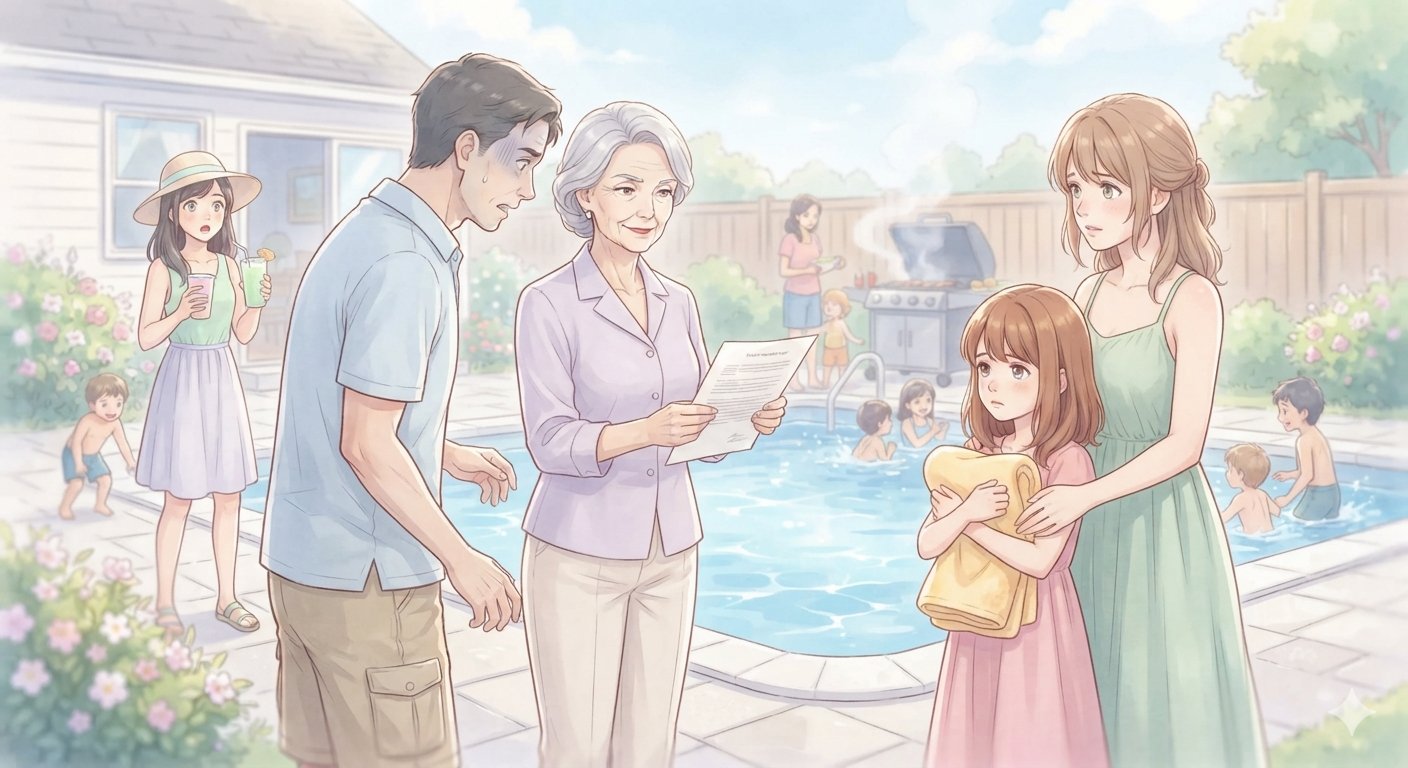
Six weeks after I told Grandma, my parents invited everyone over for the official pool reveal.
I had no intention of going.
Then Grandma called.
“I think you and Lucy should attend.”
“Why?”
“You’ll see.”
The invitation said two in the afternoon.
We arrived at two-twenty.
The backyard looked like a resort.
The pool was finished in bright blue tile.
A waterfall spilled over pale stone.
There were expensive lounge chairs, umbrellas, a built-in grill, and a television under the covered patio.
Rachel’s children were already in the water.
Relatives and neighbors stood around drinking lemonade and wine.
Mom worked the grill wearing the same practiced family-host smile she always used when she wanted everyone to believe nothing was wrong.
Lucy stayed beside me.
She held a folded towel in both hands.
Her eyes followed the water.
I knew what she was thinking.
She was looking at what her cello had become.
Rachel came over.
“You actually came.”
“Grandma asked us to.”
Her smile faltered.
“Grandma?”
Before I could answer, the back gate opened.
Grandma Margaret walked through.
Beside her was Andrew.
He carried a slim black folder.
Mom stopped smiling.
Dad, standing near the outdoor kitchen, went completely still.
Rachel lowered her drink.
Grandma walked slowly across the patio.
She looked around.
“Well,” she said pleasantly. “You’ve been busy.”
Mom gave a nervous laugh.
“Margaret, this is a party.”
“I know.”
Grandma looked at the pool.
“That’s why I came.”
Andrew handed her the folder.
The conversations around us faded.
Grandma opened it.
“I gave that cello to Lucy.”
Dad stepped forward.
“Mom—”
“Not to you.”
He stopped.
“Not to Linda.”
Mom stiffened.
“Not to Rachel.”
Grandma turned toward Lucy.
“To Lucy.”
Then she lifted the first page.
Dad reached for it.
His eyes moved across the document once.
Then again.
The color drained from his face.
Mom stepped closer.
“What is that?”
Grandma folded her hands over her cane.
“That cello was placed in the Hale Family Musical Property Trust.”
Rachel frowned.
“What does that even mean?”
Andrew answered.
“It means Mr. and Mrs. Hale did not own the instrument they sold.”
Mom looked at Dad.
Dad looked at Grandma.
“I didn’t know.”
Grandma’s expression did not change.
“You did.”
He blinked.
“What?”
“When I moved into assisted living, Andrew personally gave you a copy of the trust inventory.”
Dad’s face tightened.
“I don’t remember that.”
Andrew opened the folder.
“I have your signed receipt.”
Several relatives shifted awkwardly.
Nobody was pretending not to listen anymore.
Grandma continued.
“When Lucy turned ten, beneficial ownership passed to her. Andrew remained trustee because Lucy is a minor.”
Dad swallowed.
“We can fix this.”
Andrew gave him a level look.
“You sold trust property while falsely representing yourself as owner.”
Mom suddenly looked toward the pool.
“We can repay it.”
Grandma’s eyes followed hers.
“I suspect that may be difficult.”
Rachel stepped forward.
“Why? We’ll work something out.”
Andrew removed a second page.
“The buyer has demanded rescission of the sale.”
“What does that mean?” Rachel asked.
“He wants his eighty-seven thousand dollars back.”
Dad’s jaw clenched.
“Fine.”
Andrew continued.
“He also paid eighteen thousand dollars for specialist restoration and transport after discovering damage to the lower rib.”
Dad went pale.
“What damage?”
Grandma looked sharply at him.
“What damage?”
Dad’s voice dropped.
“There was a small crack.”
I stared at him.
“You sold it damaged?”
“It happened during storage.”
Lucy’s fingers tightened around mine.
Grandma’s face changed for the first time.
“You damaged it?”
Dad looked away.
Mom jumped in.
“It was an accident.”
“When?”
Nobody answered.
Grandma looked from one to the other.
“When?”
Rachel finally muttered, “Before the sale.”
I felt sick.
Lucy whispered, “They broke it?”
I squeezed her hand.
Grandma closed her eyes for one second.
When she opened them, the warmth was gone.
Andrew spoke carefully.
“The buyer claims the damage was not disclosed.”
Dad said, “That’s ridiculous.”
“We have your bill of sale.”
Dad went silent.
Andrew continued.
“You represented the cello as undamaged and in excellent playing condition.”
One of my uncles actually whispered, “Oh, hell.”
Mom looked around at the watching guests.
“Could we please discuss this privately?”
Grandma smiled.
“No.”
“Margaret.”
“You sold Lucy’s cello privately. You lied privately. You spent the money publicly.”
She gestured toward the pool.
“So we can discuss the consequences publicly.”
Rachel’s cheeks turned red.
“This is humiliating.”
Grandma looked at her.
“Imagine being eleven and discovering your family sold the most important gift you ever received because they wanted a swimming pool.”
Rachel said nothing.
Dad rubbed his forehead.
“What happens if we can’t repay the buyer immediately?”
Andrew removed another document.
“This is where matters become more complicated.”
Mom whispered, “What now?”
“The cello was insured.”
Dad stared at him.
“So?”
“Under the trust’s policy.”
Andrew paused.
“The insurer was notified of the unauthorized sale.”
Mom’s face went white.
Grandma turned to me.
“Emily, do you remember asking me how valuable the cello was?”
I nodded.
“You told me the old appraisal was two hundred and forty thousand.”
“That was the insurance appraisal.”
She looked at my parents.
“The historical valuation is another matter.”
Dad frowned.
“What historical valuation?”
Grandma’s eyes settled on Lucy.
“This is the part I intended to tell you when you were older.”
Lucy stared at her.
Grandma reached out.
Lucy walked toward her.
Grandma took her hand.
“The cello was made in northern Italy around 1760. It was not made by Giovanni Battista Guadagnini himself, as some people once believed, but it came from a workshop connected to his tradition.”
Everyone was silent.
Grandma continued.
“My teacher bought it in Europe after the war. When he died, he left it to me.”
Lucy whispered, “Your teacher gave it to you?”
“Yes.”
“Why?”
“Because I was the student who stayed after lessons to clean the practice room.”
Lucy smiled faintly.
Grandma squeezed her hand.
“He used to say talent was common and devotion was rare.”
Then Grandma looked at Dad.
“Three months ago, before any of this happened, Andrew arranged an updated specialist evaluation for the trust.”
Dad’s voice was barely audible.
“How much?”
Grandma smiled.
“The preliminary estimate was between four hundred and fifty and five hundred thousand dollars.”
Nobody moved.
Even the children in the pool had gone quiet because they sensed something serious was happening.
Rachel looked like she might be sick.
Mom grabbed the back of a chair.
“You’re saying we sold a half-million-dollar cello for eighty-seven thousand dollars?”
Grandma’s expression was almost gentle.
“No, Linda.”
She paused.
“You sold Lucy’s half-million-dollar cello.”
That distinction landed like a hammer.
Dad sank into a patio chair.
Mom whispered, “We didn’t know.”
Grandma replied, “You didn’t care.”
Andrew explained what would happen next.
The buyer, a private collector named Victor Lang, had initially believed Dad’s ownership documents were legitimate.
Once contacted, he cooperated.
